Showing posts with label Celestron AVX. Show all posts

Wednesday, July 13, 2022

Globular Clusters

This is the time of the year to image globular clusters, some of my favorite targets. The bulk of them tend to be low in the southern sky which is a challenge considering seeing and refraction. M13 was included in the previous post. Several others acquired on the same night appear below. M55 was acquired on a later night. Images were averaged from 30x30s subframes acquired at 120 unity gain. Configuration was Celestron 8 , Starizona NightOwl 0.4x focal reducer, ZWO ASI294MC Pro CMOS camera. Update: Images reprocessed with GraXpert stretching and residual gradient removal.

Messier 3

Messier 4

Messier 5

Messier 10

Messier 12

Messier 13
Messier 55


Tuesday, July 12, 2022

Seasonal Favorites

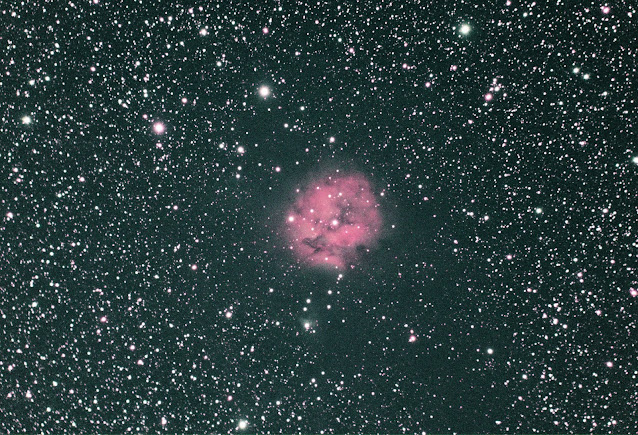
It's that time of the year, mid summer, to revisit old favorites. I never tire trying to better myself imaging these or other targets. All my recent imaging has been done from increasingly light polluted Harvard MA. Poorly targeted and excessive LED lighting is really trying to kill off night. Nonetheless the Milky Way can still be glimpsed overhead from Harvard. Typically 30 to 60 30 second exposures are acquired at F/4 using the Starizona Night Owl focal reducer corrector, light pollution filter and ZWO ASI294MC Pro using 120 unity gain. Subframes are stacked and averaged with Autostakkert! 3.  Images histograms stretched and images processed in PaintShop Pro 2021. Additional processing done in using Microsoft Photos bundled with Windows 10. 

IC5146 - Cocoon Nebula

Messier 8 - Lagoon Nebula

Messier 16 - Eagle Nebula

Messier 17  - Swan or Omega Nebula

Messier 20 - Triffid Nebula

NGC7023 - Iris Nebula
Messier 13

NGC7380

NGC6992 Eastern Veil Nebula


Wednesday, October 20, 2021

A Couple of Globular Clusters (5/15/2021)

Messier 3 and Messier 52 captured in May. Celestron 8 on Celestron AVX mount, Starizona Night Owl, ASI294MC Pro. Exposure 30 x 30s. Guided by Orion Magnificent Mini Autoguider. 

.
Messier 3

Messier 52

Monday, March 22, 2021

Into Spring

Spring has arrived, so I've decided to get a jump on galaxy season. One non-galaxy target, overlooked by me in the past, is the gaseous nebula NGC2174. It was during an earlier open cluster imaging night that I noticed its nebulosity while imaging its associated open cluster NGC2175. Imaging wasn't under the best conditions, the heavily light polluted count of Frederick, MD, so I'll likely revisit NGC2174 in the future. It appears below along with five galaxies. All imaging was done at F/4 with a Starizona Night Owl focal reducer/corrector. Am, I glad I acquired this accessory before the SARS Covid-2 pandemic as it's been out of stock for months.  NGC2174 and NGC2175 were averaged from 60s sub frames. The galaxies were averaged  from 120s sub frames.

NGC2174 (gaseous nebula) and NGC2175 (open cluster)

M94 (galaxy)

M106 (galaxy)

M109 (galaxy)

NGC2403 (galaxy)

NGC2841(galaxy)


Monday, September 21, 2020

AVX Hardware Tuning

Recently, thanks to YouTube tutorial, I adjusted the AVX mount gears to reduce the large amount of RA backlash. I also made a few PHD2 settings adjustments. I had been using the recommended 1.5 to 3s guide camera exposures. I reduced that to 1.0s and reduced the RA aggressiveness to an experimental 50%. These changes have resulted in an improvement in guiding as evidenced by rounder stars and a less noisy guiding graph. The images below were acquired over two days of imaging. 

Messier 11 (Wild Duck Cluster)
NGC 6960 (Eastern Veil Nebula)

NGC 6992 (Western Veil Nebula)
NGC 7635 (Bubble Nebula)
Sharpless 125 (Cocoon Nebula)
NGC 281 (Pacman Nebula)

Sunday, August 23, 2020

Better night than expected - 08/20/2020

Thursday 8/20/2020 promised to be clear night with average seeing according to Clearsky Charts and NOAA. I decided to head for the Harvard library darksite with the goal of imaging the Crescent, the Eastern and Western Veil nebulae using the Starizona Night Owl gambling on 120s sub frames at f/4. That proved a mistake. The results were under exposed and noisy. I won't bother posting the images here. In the future I will try imaging with 300s sub frames that yielded better results at a higher f/6.4 focal ratio in the past. 

Fortunately, I also imaged Comet Neowise, M8, M16, M17, M20 and M13 on the same night. Sub frames were acquired with 30s exposures at a gain of 120.  The images appear below. The images are pretty okay but could be  better. The auto-guider was quite erratic along the RA axis resulting in elongated stars. With the waxing moon I will focus on debugging this issue locally starting with running the PHD2 setup wizard. 

On a different note flat frames captured during twilight were at the wrong focus making them useless. I decided to keep the optical assembly together and collect a set of flat frames at home next day. The first set, taken from a lamp illuminated wall looked good but yielded ugly images marred with gradients. At first I assumed the problem was camera settings and light pollution. On a whim I tried using a white jpeg image on my LED HDTV screen as a flat frame target. It worked resulting in the  images below. 😊

Comet C/2020 F3 Neowise

M8 (Lagoon Nebula)

M16 (Eagle Nebula)

M17 (Omega Nebula)

M13 (Hercules Cluster)

M20 (Trifid Nebula)

Friday, May 29, 2020

Ad hoc bonus night

If the NOAA forecast for a dark site is partly cloudy I don't bother planning a DSO imaging mission. However, on the afternoon of this mission I noticed the skies were sunny and cloudless. Upon checking Clear Sky Chart for Harvard MA it was forecasting an above average viewing night. Other than picking a few Galaxy Season targets little planning was needed. The night went well with the images appearing below. Galaxy images were averaged from 15x60s exposure sub frames. Globular clusters were averaged from 25x30s exposure sub frames.

M51
Messier 51 (Whirlpool Galaxy)

 
Messier 64(Black Eye Galaxy)

Messier 3

Messier 53

Messier 85(center) and NGC 4394(lower center)

M86 (low right), M84(upper center),
NGC4402(lower left), NGC4388(right center)


NGC4565

Wednesday, March 25, 2020

M81, M82, M51, NGC2841

It's Spring and with Coma Berenices with its accompanying cluster of galaxies it's the beginning of galaxy season. I thought I would get a head start  practicing on with three of my favorite galaxies M81, M82 and M51. NGC2841 is thrown in as a bonus. These won't be my only  visits to these non-Coma Berenices targets as they grace my northern hemisphere zenith during the next month or so. The Coma cluster requires I get out of heavily light polluted Frederick Maryland  to one of my darkish sites and when the galaxies are highest in the southern sky. 

Sadly, as I write this, the world is in the midst of a crippling, deadly pandemic due to the covid-19 corona virus. The effects on public health and the world economy are still to be played out. I'm fortunate, a lifelong saver/investor to be in a decent financial position despite taking a hit in the stock market. I can also be grateful for a mind engaging hobby, this one, to distract me from the current goings on. Folks, follow the experts, hand washing, social distancing, staying at home if you can. We're in for pain but will get through this. 

M81 -- 15x120s @bin1

M82 -- 15x180s @bin1

M51 -- 12x180s @bin1

NGC2481 -- 10x180s @bin1

Sunday, December 8, 2019

Orion Skyglow Astrophotography Filter - First Night Out

First off a night with a 66% waxing moon is far from an ideal test night. The purpose of Orion SkyGlow Astrophotography Filter is to remove various bands of artificial outdoor lighting. The moon is broad band reflected sunlight which is not fully filterable. Also making this night non-ideal was high clouds that moved in far sooner than the forecast 2300 EST cutting short the night. 

 That said I was able to image NGC7635, the bubble nebula using 15x2 min and 6x5 min  sub-frames. The Starizona Night Owl 0.4X focal reducer was used for imaging. Images were processed using Paintshop ProX9. To give a direct comparison between the two images the six steps used to process the 6x2min image were saved to a script which was then applied to the 15x2 min case. The process and cropped images appear below. 

On another note I am finding images acquired with the Starizona Night Owl are far more susceptible to the exposure conditions of the flat frames used in stacking. I image using SharpCap 3.2 and acquire flat frames over a range of exposures while keeping the logarithm of the histogram as close to a 20% to 80% range. In any case I would consider either image below to be acceptable considering the phase of the moon.
NGC7635 -- 15x2 min


NGC7635 -- 6x5 min

Thursday, November 28, 2019

New Starizona Night Owl Focal Reducer -- Updated

For some time I have used the combo 0.63x focal reducer(FR) and diagonal to achieve about an f/5 focal ratio with some rather distorted stars out to the edge of the ASI 294MC Pro with its 16x13mm sensor. Recently I procured a Starizona Nightowl FR which promises .. "to provide excellent image quality over a 16mm image circle." This is a bit of an over promise. Even near the 13mm dimension edge of the ASI294MC star distortion is quite evident; albeit less objectionable than the aforementioned 0.63x FR optical configuration. 

A bigger concern is uneven background vignetting. This is expected in any optical system which is why flat field correction is essential. However, in just my short experience with the Night Owl there is a small residual greenish glow  evident in the center of the Horsehead Nebula and NGC1981 images even after applying several flat fields acquired at different exposures. Imaging was from  a quite light polluted area, Frederick, Maryland and it's hoped a Orion SkyGlow Astrophotography Filter will help with this. Meanwhile here are a few early results. 

Update: Since this writeup almost all NightOwl images have been acquired at 3104x2116 or 3104x2844 pixel formats. At these formats flat frames are effective eliminating the residual greenish glow in the center of DSO images. I now do all NightOwl imaging at the 3104x2844 format. 

Barnard 33(Horse Head Nebula), NGC2023, 
NGC 2024(Flame Nebula)

Sharpless 279, NGC1981