Showing posts with label M8 (Lagoon Nebula). Show all posts

Tuesday, July 12, 2022

Seasonal Favorites

It's that time of the year, mid summer, to revisit old favorites. I never tire trying to better myself imaging these or other targets. All my recent imaging has been done from increasingly light polluted Harvard MA. Poorly targeted and excessive LED lighting is really trying to kill off night. Nonetheless the Milky Way can still be glimpsed overhead from Harvard. Typically 30 to 60 30 second exposures are acquired at F/4 using the Starizona Night Owl focal reducer corrector, light pollution filter and ZWO ASI294MC Pro using 120 unity gain. Subframes are stacked and averaged with Autostakkert! 3.  Images histograms stretched and images processed in PaintShop Pro 2021. Additional processing done in using Microsoft Photos bundled with Windows 10. 

IC5146 - Cocoon Nebula

Messier 8 - Lagoon Nebula

Messier 16 - Eagle Nebula

Messier 17  - Swan or Omega Nebula

Messier 20 - Triffid Nebula

NGC7023 - Iris Nebula
Messier 13

NGC7380

NGC6992 Eastern Veil Nebula


Sunday, August 23, 2020

Better night than expected - 08/20/2020

Thursday 8/20/2020 promised to be clear night with average seeing according to Clearsky Charts and NOAA. I decided to head for the Harvard library darksite with the goal of imaging the Crescent, the Eastern and Western Veil nebulae using the Starizona Night Owl gambling on 120s sub frames at f/4. That proved a mistake. The results were under exposed and noisy. I won't bother posting the images here. In the future I will try imaging with 300s sub frames that yielded better results at a higher f/6.4 focal ratio in the past. 

Fortunately, I also imaged Comet Neowise, M8, M16, M17, M20 and M13 on the same night. Sub frames were acquired with 30s exposures at a gain of 120.  The images appear below. The images are pretty okay but could be  better. The auto-guider was quite erratic along the RA axis resulting in elongated stars. With the waxing moon I will focus on debugging this issue locally starting with running the PHD2 setup wizard. 

On a different note flat frames captured during twilight were at the wrong focus making them useless. I decided to keep the optical assembly together and collect a set of flat frames at home next day. The first set, taken from a lamp illuminated wall looked good but yielded ugly images marred with gradients. At first I assumed the problem was camera settings and light pollution. On a whim I tried using a white jpeg image on my LED HDTV screen as a flat frame target. It worked resulting in the  images below. 😊

Comet C/2020 F3 Neowise

M8 (Lagoon Nebula)

M16 (Eagle Nebula)

M17 (Omega Nebula)

M13 (Hercules Cluster)

M20 (Trifid Nebula)

Thursday, November 28, 2019

Recent and not so recent DSO images

These images were typically acquired using a Celestron 0.63x focal reducer with or without a diagonal. With the diagonal a non optimal F/4 focal ratio is achieved. With my typical straight through configuration with 108 mm gap between the focal reducer and the sensor yields ~F/6.3. Imager was ZWO ASI294MC-Pro @0C or 10C depending on ambient temperature.

Processing is with AutoStakkert for averaging subframes, Paintshop Pro X9 for image processing. In some cases the minimalist Fix app built into Window 10 Photo Gallery was used to tweak the image.

NGC 6960 - Western Veil Nebula

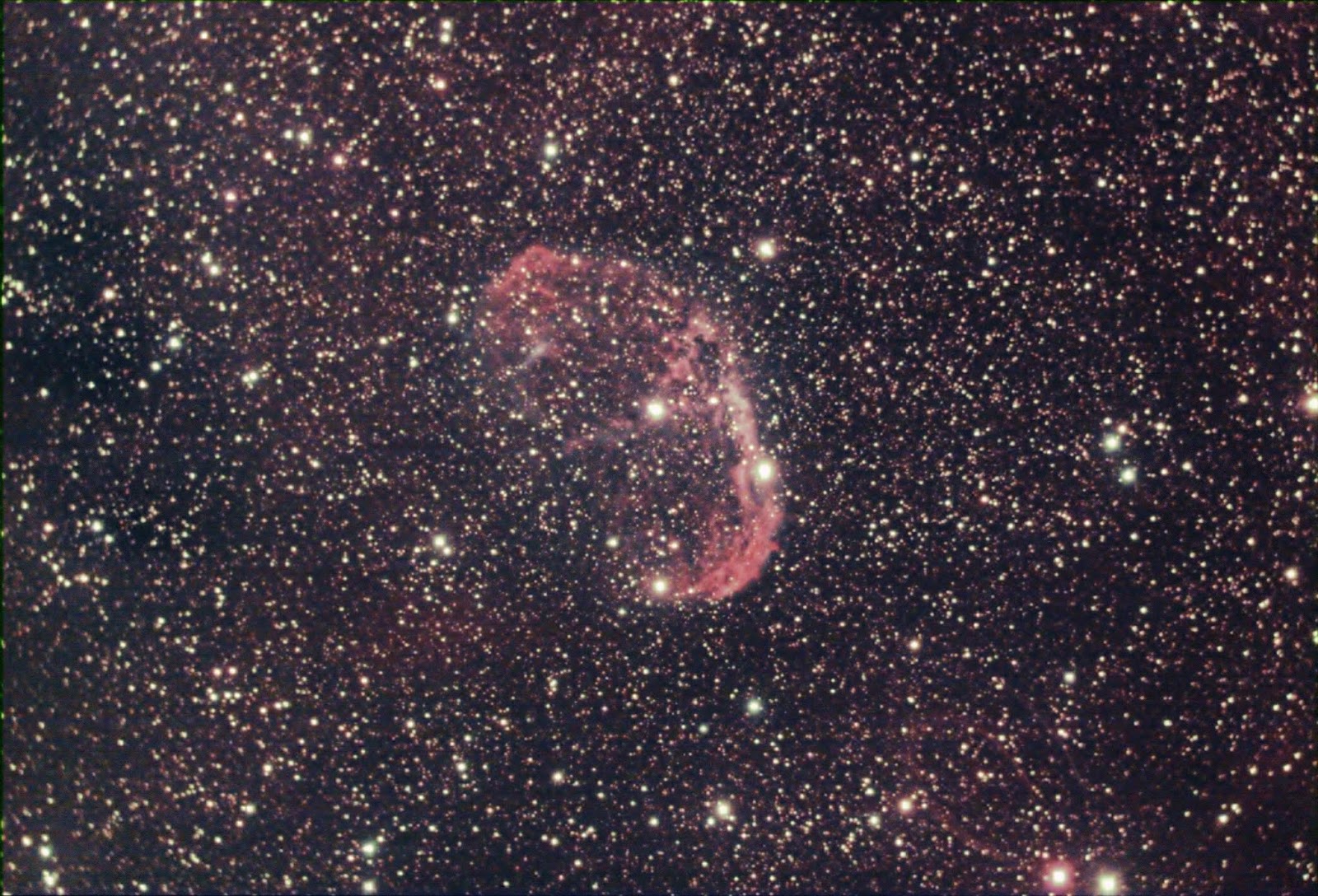
NGC6888 -Crescent Nebula

 ZWO ASI294MC Pro series of 180s exposures
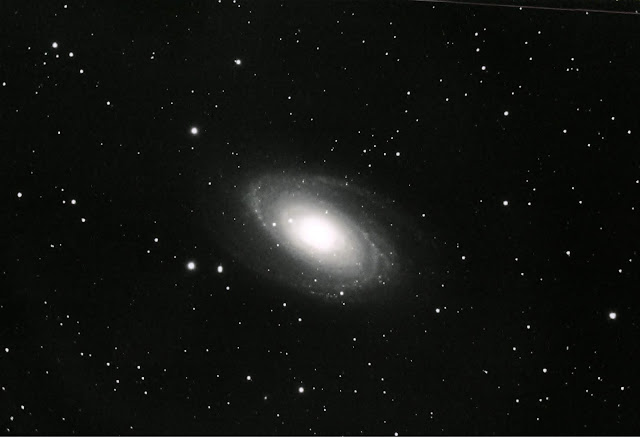
Messier 81- Bode's Galaxy
Planetary nebular: Average of 8x180s, ASI294MC Pro
Messier 27 - Dumbell Nebula
NGC6992 - Eastern Veil Nebula

ASI294MC Pro, 10x120s exposures
Messier 8 - Lagoon Nebula

ASI294MC Pro, series of 30s exposures
Messier 31- Andromeda Galaxy

ASI294MC Pro, Average of 15x60s exposures
Messier 16 - Eagle Nebula

ASI294MC Pro, 20x30s averaged.
Messier 17 Omega Nebula