Showing posts with label Horsehead nebula. Show all posts

Thursday, March 16, 2023

GraXpert game changing freeware.

A number of weeks ago I stumbled upon a game changing piece of freeware, GraXpert. GraXpert's algorithm analyzes your deep sky image distinguishing stars and nebulosity from back ground sky and generates a background that eliminates gradients and reduces light pollution. A standalone app GraXpert is easy to use while offering settings that allow you to tweak the algorithm for better results. Prior to downloading this awesome piece of free software dealing with gradients, inherent to my  ASI294MC Pro was a bit tedious. With GraXpert you just load the stretched image*, create the grid, calculate the back ground and save the processed image. That's it. You can adjust the sensitivity of the grid creating algorithm to background intensity and you can move, add or delete grid points to distinguish nebulosity from the background. Aside from reducing my workload the colors in my images have improved. Some recent images follow. Thor's Helmet nebula was actually imaged from my 3rd floor balcony in my heavily light polluted south of Boston suburban skies with 120 15s sub exposures. 

*Stretching the histogram in Paintshop Pro seems preferable to the GraXpert stretching routine which seems to throw away black side data. 

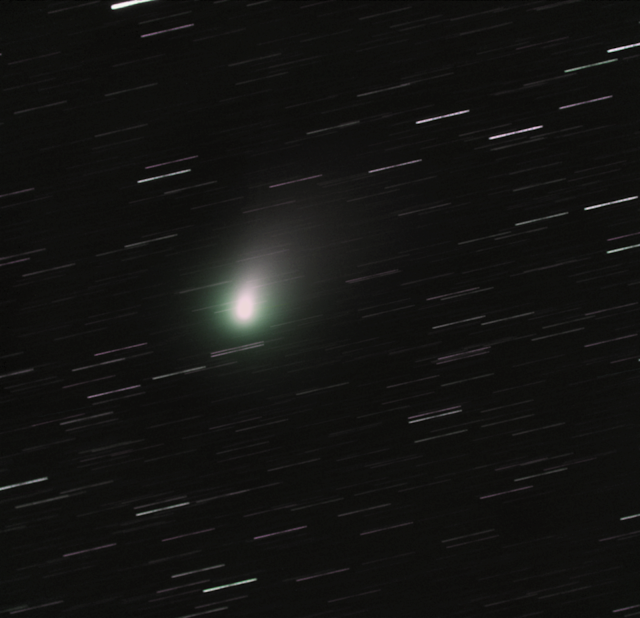
Comet C2022E3 ZTF (2/15/2023)

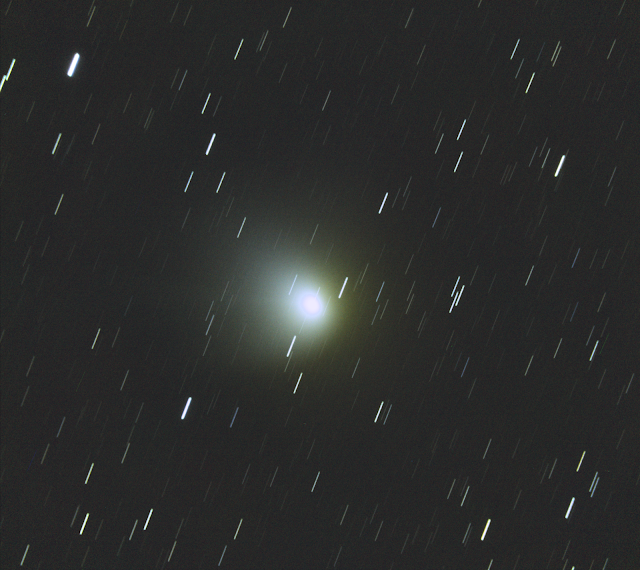
Comet C/2022E3 ZTF  (2/8/2023)

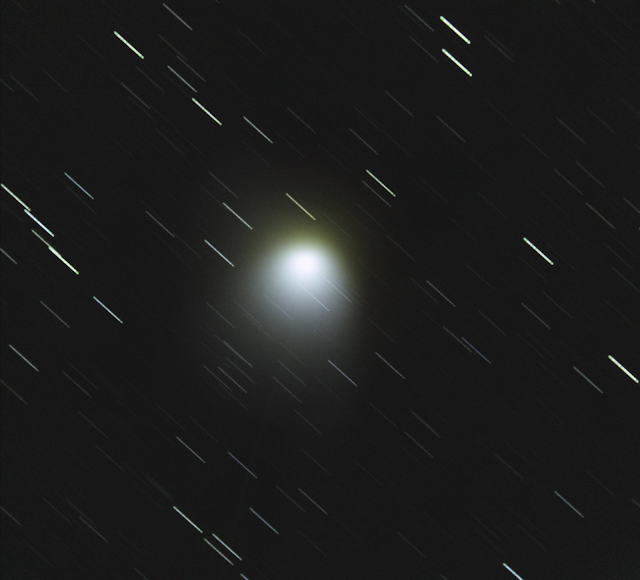
Comet C2022E3 ZTF (1/30/2023)

Comet C/2022E3 ZTF (1/27/2023)

IC443, Sharpless 248, Jellyfish Nebula--Supernova Remnant. 

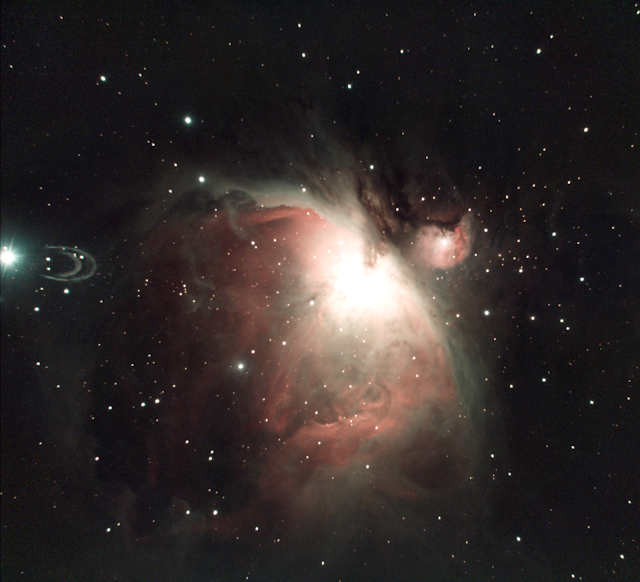
M42 Orion Nebula

M48 --Open Cluster

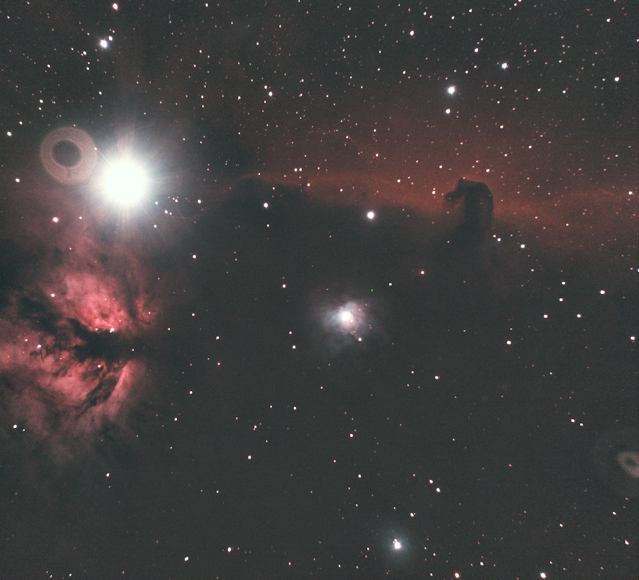
Flame Nebula (NGC2024) , NGC2023, Horsehead Nebula(B33)

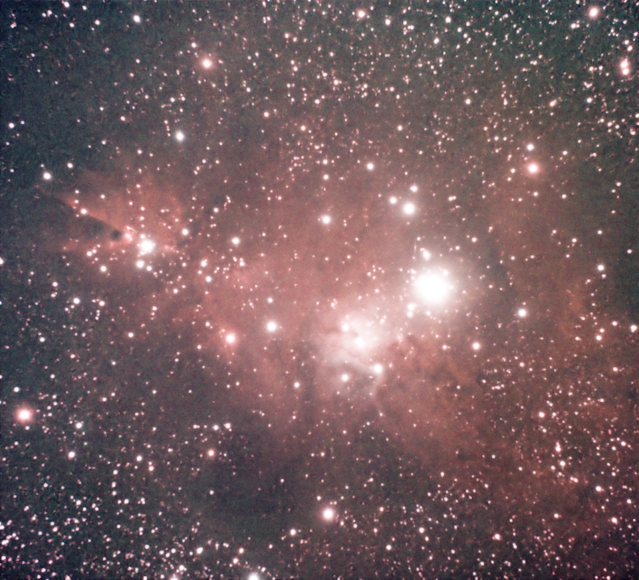
NGC2264

NGC2353 Open Cluster

NGC2359 (Thor's Helmet Nebula)

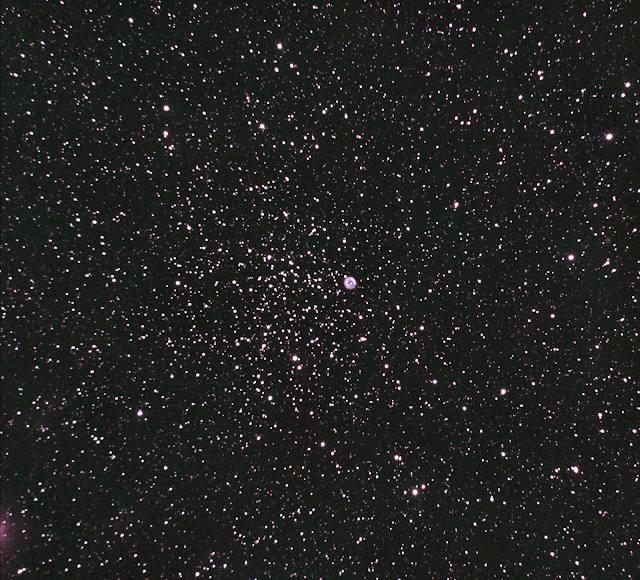
M46(NGC2437) Open Cluster + Planetary Nebula NGC2437

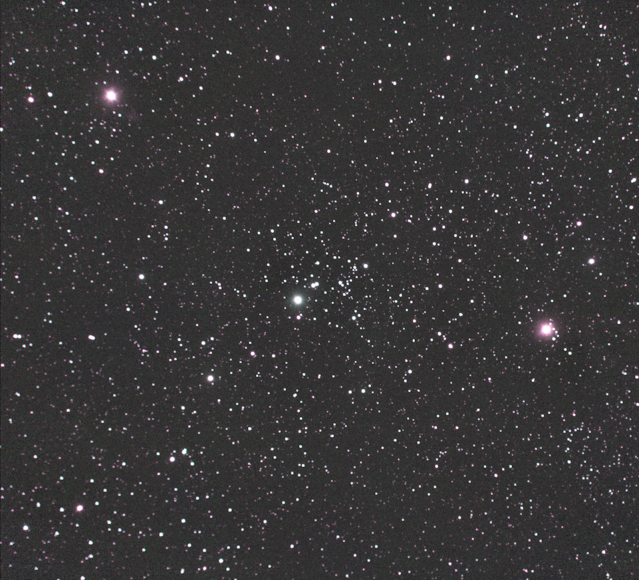
NGC2232 Open Cluster

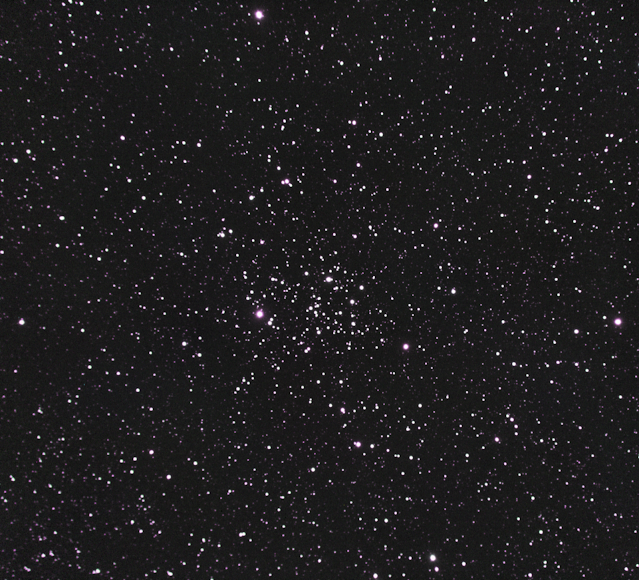
Messier 50 Open Cluster

Sunday, January 1, 2023

Happy 2023 from the Terrace

The condo association gave me an early Christmas gift cutting down the sky obscuring dying tree outside my terrace. Trees across the way still block my light polluted skies. Nonetheless, I now have a descent strip of sky between 20 and 45 degrees altitude to work with during Orion season. I'll still make trips to my favorite darkish site in Harvard, MA but this will cut down on my carbon footprint as well as freezing toes during winter months. An additional benefit is access to WiFi allows me to monitor the scope using Chrome remote desktop. I'm pleasantly surprised with NGC2359 acquired with 15s subs which I first imaged with 60s subs last April from the McCoy's landing darkish site.  I'll definitely revisit NGC2359 between now and April from the terrace. 

The experiment with finder only All Star Polar Alignment has worked better than expected. Typically, I have only needed the two alignment stars plus two calibration stars after rough alignment with Polaris which is not visible from my south facing terrace. Typically less than 2 degrees of azimuth and less than 1 degree of altitude correction have been needed to correct for axis deviation from polar alignment. Thus far the Celestron AVX GoTo puts targets in the NightOwl  field of view (FOV). To center faint targets I just use Precise Goto which puts a bright star in the field which when centered in the FOV and centers the target with an offset.  Below are targets acquired on 12/27/2022 using 60x15s or 120x15s exposures.  Update: M42 reprocessed for reduced contrast and saturation.

M77 Irregular Galaxy

NGC 1788 Reflection Nebula

Left to Right: NGC2024(Flame Nebula), NGC2023, Horsehead Nebula (B33)


NGC2359 (Thor's Helmet) -- To be revisited

Orion Nebula (M42) again 😂


Monday, December 19, 2022

Alignment and Guiding Experiment

After setting up the telescope I usually do a Celestron AVX all star polar alignment (ASPA) using the visual finder for rough centering then fine centering on the computer screen with the ASI294MC Pro. I thought this might be bit of overkill considering the use of the Orion Magnificent Mini Autoguider. I setup the scope on my 3rd floor patio, as lousy a place for viewing considering no access to Polaris and a tree limited view. The ASPA was performed using the visual finder only starting with  rough north alignment. Jupiter, Saturn were used for alignment and Fomalhaut for calibration star. I usually use two alignment and four calibration stars in the field. Surprisingly only 7' altitude and 7' azimuth corrections were required. Pointing accuracy was less accurate than typical but was good enough to put target on the camera sensor. I had not checked the alignment of the finder with the optical train. This was good enough for M42 but not for NGC2023 so I used precision go to which uses a bright star as a waypoint to the faint target. M42 and NGC2023 with the Flame Nebula and Horsehead Nebula imaged that night appear below. Update: M42 reprocessed for reduced oversaturation.

M42

NGC 2023(center)with Flame Nebula(left) and Horsehead Nebula(right)

Update: A pleasant  start of Orion season surprise. Condo association removed twelve dead trees surrounding my building including the tree right in front of my terrace. Likely the association was prompted by the coming bomb cyclone that will hit Greater Boston with heavy rain and high winds. More sky!! 😀


Thursday, November 28, 2019

New Starizona Night Owl Focal Reducer -- Updated

For some time I have used the combo 0.63x focal reducer(FR) and diagonal to achieve about an f/5 focal ratio with some rather distorted stars out to the edge of the ASI 294MC Pro with its 16x13mm sensor. Recently I procured a Starizona Nightowl FR which promises .. "to provide excellent image quality over a 16mm image circle." This is a bit of an over promise. Even near the 13mm dimension edge of the ASI294MC star distortion is quite evident; albeit less objectionable than the aforementioned 0.63x FR optical configuration. 

A bigger concern is uneven background vignetting. This is expected in any optical system which is why flat field correction is essential. However, in just my short experience with the Night Owl there is a small residual greenish glow  evident in the center of the Horsehead Nebula and NGC1981 images even after applying several flat fields acquired at different exposures. Imaging was from  a quite light polluted area, Frederick, Maryland and it's hoped a Orion SkyGlow Astrophotography Filter will help with this. Meanwhile here are a few early results. 

Update: Since this writeup almost all NightOwl images have been acquired at 3104x2116 or 3104x2844 pixel formats. At these formats flat frames are effective eliminating the residual greenish glow in the center of DSO images. I now do all NightOwl imaging at the 3104x2844 format. 

Barnard 33(Horse Head Nebula), NGC2023, 
NGC 2024(Flame Nebula)

Sharpless 279, NGC1981