Showing posts with label NGC7635(Bubble Nebula). Show all posts

Monday, September 21, 2020

AVX Hardware Tuning

Recently, thanks to YouTube tutorial, I adjusted the AVX mount gears to reduce the large amount of RA backlash. I also made a few PHD2 settings adjustments. I had been using the recommended 1.5 to 3s guide camera exposures. I reduced that to 1.0s and reduced the RA aggressiveness to an experimental 50%. These changes have resulted in an improvement in guiding as evidenced by rounder stars and a less noisy guiding graph. The images below were acquired over two days of imaging. 

Messier 11 (Wild Duck Cluster)
NGC 6960 (Eastern Veil Nebula)

NGC 6992 (Western Veil Nebula)
NGC 7635 (Bubble Nebula)
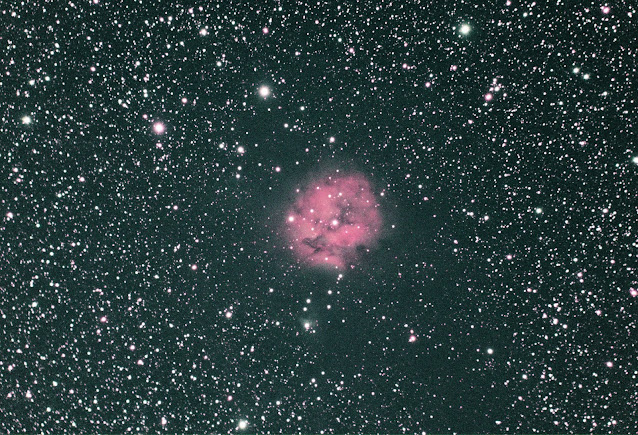
Sharpless 125 (Cocoon Nebula)
NGC 281 (Pacman Nebula)

Thursday, March 5, 2020

Comet C2017T2, IC405, IC410, M33, NGC281, M42, NGC7635

Here are a few recent images acquired this 2019 winter. All were acquired at F/4 using the recently with Celestron 8+Starizona Night Owl FR+Orion SkyGlow Astrophotography filter. Camera: ZWO ASI294MC Pro, Mount: Celestron Advanced VX, Guider: Orion Magnificent Mini Autoguider. 

Look closely at Comet C2017T2 and you might notice the glow slanting down to its left. That's residual glow not zeroed out by the flat frame. Vignetting from the Night Owl is very aggressive and tough to zero out.  

Using SharpCap 3.2 I have found collecting flat frames at a narrow range of different exposures that give a histogram just above and below the "above 20%" criterion should provide a flat frame that does a good job zeroing out vignetting and artifacts. *

* More recently I have found a 20% to 80% histogram range, as recommended by SharpCap documentation works best. 

Update:03/13/2025 M33 reprocessed 


Comet C2017T2 PANSTARRS -- 15x60s @bin2


IC410 -- 6x300s @bin1

M33 (180s exposures)

IC405 -- 6x300s @ bin1

NGC281 -- 10x180s @bin1

M42 -- 25x8s @bin1

NGC7635 -- 6x300s @ Bin1

Sunday, December 8, 2019

Orion Skyglow Astrophotography Filter - First Night Out

First off a night with a 66% waxing moon is far from an ideal test night. The purpose of Orion SkyGlow Astrophotography Filter is to remove various bands of artificial outdoor lighting. The moon is broad band reflected sunlight which is not fully filterable. Also making this night non-ideal was high clouds that moved in far sooner than the forecast 2300 EST cutting short the night. 

 That said I was able to image NGC7635, the bubble nebula using 15x2 min and 6x5 min  sub-frames. The Starizona Night Owl 0.4X focal reducer was used for imaging. Images were processed using Paintshop ProX9. To give a direct comparison between the two images the six steps used to process the 6x2min image were saved to a script which was then applied to the 15x2 min case. The process and cropped images appear below. 

On another note I am finding images acquired with the Starizona Night Owl are far more susceptible to the exposure conditions of the flat frames used in stacking. I image using SharpCap 3.2 and acquire flat frames over a range of exposures while keeping the logarithm of the histogram as close to a 20% to 80% range. In any case I would consider either image below to be acceptable considering the phase of the moon.
NGC7635 -- 15x2 min


NGC7635 -- 6x5 min