Friday, May 29, 2020

Ad hoc bonus night

If the NOAA forecast for a dark site is partly cloudy I don't bother planning a DSO imaging mission. However, on the afternoon of this mission I noticed the skies were sunny and cloudless. Upon checking Clear Sky Chart for Harvard MA it was forecasting an above average viewing night. Other than picking a few Galaxy Season targets little planning was needed. The night went well with the images appearing below. Galaxy images were averaged from 15x60s exposure sub frames. Globular clusters were averaged from 25x30s exposure sub frames.

M51
Messier 51 (Whirlpool Galaxy)

 
Messier 64(Black Eye Galaxy)

Messier 3

Messier 53

Messier 85(center) and NGC 4394(lower center)

M86 (low right), M84(upper center),
NGC4402(lower left), NGC4388(right center)


NGC4565

Friday, May 22, 2020

Galaxy Season

The coronavirus pandemic put my astro-imaging on hold. Two favorite Harvard MA public area dark sites are temporarily closed due to the pandemic. Luckily I was recently able to image from the unlighted parking lot of a friendly fruit stand with a great view of the skies. Thanks to surrounding towns Harvard's skies are starting to rival the light polluted skies of Boston suburbs. That said they are still worth traveling to.

With two rare clear sky nights in a row I was able to do quite a bit of galaxy imaging using the Starizona Night Owl focal reducer alluded to in earlier posts. I decided to experiment with 15 x 1min sub-frames instead of the more typical 6 x 5min I've used in the past. The results are a pleasant surprise. UPDATE: Actually, according to Robin Glover's CMOS color camera astrophotography YouTube video it's not such a surprise after all. 

Interesting note: Images from the first and better night sky-wise were plagued with an unpleasant gradient brightening on the left side. I hypothesized was due to flat frames with histograms with too many points below 20%. Flat frame histograms should fall between 20% and 80%.  I adjusted this on the second night and in a Hail Mary play applied one of these flats to the previous night's images. Any serious imager knows this is a no-no because flats must be taken with the exact optical configuration used to acquire the images. Despite this, the result was a successful, albeit imperfect salvaging operation made possible because I typically insert the camera with the same orientation around to the telescope's optical axis. 

Note: Galaxy Season refers to the many Coma cluster galaxies in the  in the southern spring evening sky. Also, Galaxy season doesn't preclude imaging comets, globular clusters or gaseous nebulae as exemplified by the first four images.
 
Comet C/2017T2 PANSTARRS

.Messier 3 Globular Cluster 

Messier 13 

Messier 97 Owl Nebula

Messier 51 Whirlpool Galaxy

Messier 63 Sunflower Galaxy

Messier 85

Messier 94

Messier 101

Messier 106

Messier 109
NGC4613 Whale Galaxy

Wednesday, March 25, 2020

M81, M82, M51, NGC2841

It's Spring and with Coma Berenices with its accompanying cluster of galaxies it's the beginning of galaxy season. I thought I would get a head start  practicing on with three of my favorite galaxies M81, M82 and M51. NGC2841 is thrown in as a bonus. These won't be my only  visits to these non-Coma Berenices targets as they grace my northern hemisphere zenith during the next month or so. The Coma cluster requires I get out of heavily light polluted Frederick Maryland  to one of my darkish sites and when the galaxies are highest in the southern sky. 

Sadly, as I write this, the world is in the midst of a crippling, deadly pandemic due to the covid-19 corona virus. The effects on public health and the world economy are still to be played out. I'm fortunate, a lifelong saver/investor to be in a decent financial position despite taking a hit in the stock market. I can also be grateful for a mind engaging hobby, this one, to distract me from the current goings on. Folks, follow the experts, hand washing, social distancing, staying at home if you can. We're in for pain but will get through this. 
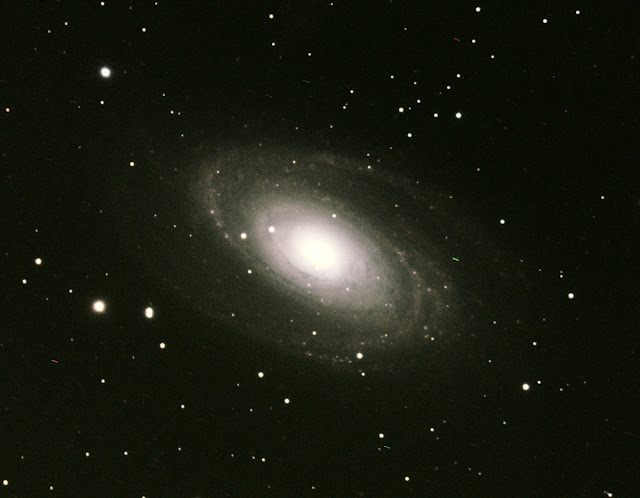
M81 -- 15x120s @bin1

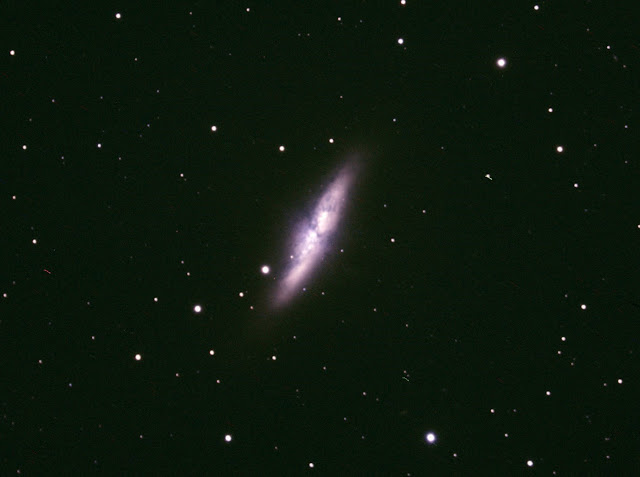
M82 -- 15x180s @bin1

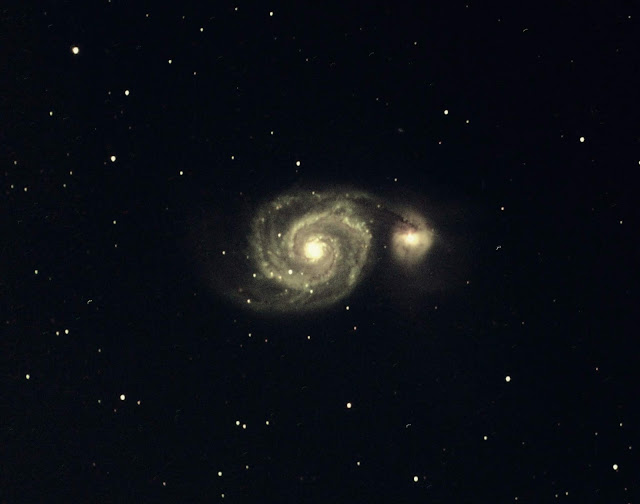
M51 -- 12x180s @bin1

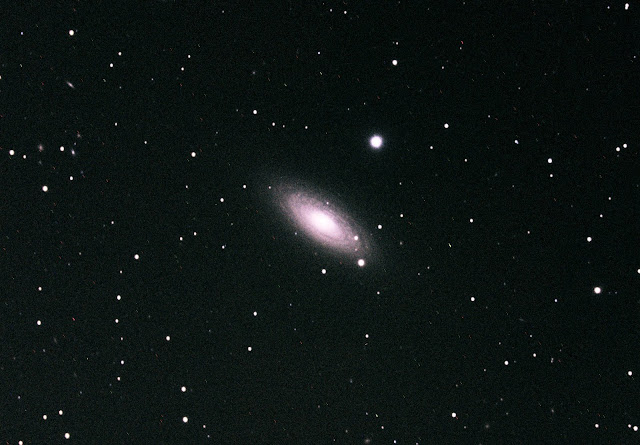
NGC2481 -- 10x180s @bin1

Thursday, March 5, 2020

Comet C2017T2, IC405, IC410, M33, NGC281, M42, NGC7635

Here are a few recent images acquired this 2019 winter. All were acquired at F/4 using the recently with Celestron 8+Starizona Night Owl FR+Orion SkyGlow Astrophotography filter. Camera: ZWO ASI294MC Pro, Mount: Celestron Advanced VX, Guider: Orion Magnificent Mini Autoguider. 

Look closely at Comet C2017T2 and you might notice the glow slanting down to its left. That's residual glow not zeroed out by the flat frame. Vignetting from the Night Owl is very aggressive and tough to zero out.  

Using SharpCap 3.2 I have found collecting flat frames at a narrow range of different exposures that give a histogram just above and below the "above 20%" criterion should provide a flat frame that does a good job zeroing out vignetting and artifacts. *

* More recently I have found a 20% to 80% histogram range, as recommended by SharpCap documentation works best. 

Update:03/13/2025 M33 reprocessed 


Comet C2017T2 PANSTARRS -- 15x60s @bin2


IC410 -- 6x300s @bin1

M33 (180s exposures)

IC405 -- 6x300s @ bin1

NGC281 -- 10x180s @bin1

M42 -- 25x8s @bin1

NGC7635 -- 6x300s @ Bin1

Sunday, December 8, 2019

Orion Skyglow Astrophotography Filter - First Night Out

First off a night with a 66% waxing moon is far from an ideal test night. The purpose of Orion SkyGlow Astrophotography Filter is to remove various bands of artificial outdoor lighting. The moon is broad band reflected sunlight which is not fully filterable. Also making this night non-ideal was high clouds that moved in far sooner than the forecast 2300 EST cutting short the night. 

 That said I was able to image NGC7635, the bubble nebula using 15x2 min and 6x5 min  sub-frames. The Starizona Night Owl 0.4X focal reducer was used for imaging. Images were processed using Paintshop ProX9. To give a direct comparison between the two images the six steps used to process the 6x2min image were saved to a script which was then applied to the 15x2 min case. The process and cropped images appear below. 

On another note I am finding images acquired with the Starizona Night Owl are far more susceptible to the exposure conditions of the flat frames used in stacking. I image using SharpCap 3.2 and acquire flat frames over a range of exposures while keeping the logarithm of the histogram as close to a 20% to 80% range. In any case I would consider either image below to be acceptable considering the phase of the moon.
NGC7635 -- 15x2 min


NGC7635 -- 6x5 min

Tuesday, December 3, 2019

Some Auto-guiding subtleties - Updated

One of my early postings on the Orion Magnificent Mini Autoguider talked about how well it guided from my second floor patio despite mediocre alignment. Surprisingly it hasn't always been as smooth out in the field even when my Celestron 8 Advanced AVX system was well aligned using the All Star Polar Alignment (ASPA) method. The problem? Balance.

Early on I assumed I could get away with balancing and ASPA aligning the scope using the Celestron RACI visual finder then swapping that finder with the auto-guider which is mounted on the other side of the scope. The guider and finder are about the same weight.  It turns out the balances are not as equivalent as I thought. Often I found the auto-guider would not guide well depending on the direction the scope pointed. Various calibrations and setting changes did not help.

Then it dawned on me to try balancing the scope with the auto-guider mounted then swap the auto-guider for the visual finder to do the ASPA. Then re-swap the finder for the auto-guider. This pretty much eliminated guiding problems. Typically I still re-calibrate if I point to a far different part of the sky; no big deal as calibration takes less than 5 minutes.

The auto-guider is controlled by PHD2 software a sophisticated but easy to use free application originally created by Stark Labs then released as open source. One tip in the comprehensive help I have found useful is to move the scope at 10 to 20 seconds North(or South) before calibration. This generally eliminated a frequent 'not enough movement' error.

On a different note I just procured a 2" Orion SkyGlow Astrophotography Filter to deal with light pollution. Until now I have been using an older Orion Orion SkyGlow Broadband filter which is not really intended for astro-imaging.

Update: The retainer Orion SkyGlow Filter uses a poorly made flimsy plastic retainer ring susceptible to coming loose. This became evident after the filter was out of warranty. Ultimately the ring popped out during tear down after a night of imaging allowing the filter to fall out and break. The filter was replaced with an Optolong light pollution filter. I would recommend avoiding Orion filters. 

Thursday, November 28, 2019

New Starizona Night Owl Focal Reducer -- Updated

For some time I have used the combo 0.63x focal reducer(FR) and diagonal to achieve about an f/5 focal ratio with some rather distorted stars out to the edge of the ASI 294MC Pro with its 16x13mm sensor. Recently I procured a Starizona Nightowl FR which promises .. "to provide excellent image quality over a 16mm image circle." This is a bit of an over promise. Even near the 13mm dimension edge of the ASI294MC star distortion is quite evident; albeit less objectionable than the aforementioned 0.63x FR optical configuration. 

A bigger concern is uneven background vignetting. This is expected in any optical system which is why flat field correction is essential. However, in just my short experience with the Night Owl there is a small residual greenish glow  evident in the center of the Horsehead Nebula and NGC1981 images even after applying several flat fields acquired at different exposures. Imaging was from  a quite light polluted area, Frederick, Maryland and it's hoped a Orion SkyGlow Astrophotography Filter will help with this. Meanwhile here are a few early results. 

Update: Since this writeup almost all NightOwl images have been acquired at 3104x2116 or 3104x2844 pixel formats. At these formats flat frames are effective eliminating the residual greenish glow in the center of DSO images. I now do all NightOwl imaging at the 3104x2844 format. 

Barnard 33(Horse Head Nebula), NGC2023, 
NGC 2024(Flame Nebula)

Sharpless 279, NGC1981