 |
| IC405 |
 |
| IC410 |
 |
| IC447 |
 |
| NGC2174 |
 |
| NGC2264 |
 |
| M3 |
Below are some of the better DSO images acquired between the title dates. The usual setup Celestron 8, Starizona Night Owl(F/4) focal reducer corrector, ASI294 MC Pro guided by Celestron AVX and Orion Magnificent Mini Auto-guider.
 |
| Messier 46 (Open Cluster), NGC2438 (Planetary Nebula) |
 |
| NGC2301 (Open Cluster) |
 |
| NGC2353 (Open Cluster) |
 |
| Messier 34 (Open Cluster) |
 |
| Messier 103 (Open Cluster) |
 |
| NGC129 (Open Cluster) |
 |
| NGC281 (Pacman Nebula) |
 |
| NGC1528 (Open Cluster) |
 |
| NGC1545 (Open Cluster) |
 |
| IC410 (Star Forming Region) |
 |
| Barnard 33 (Horsehead Nebula), NGC2023 (Reflection Nebula) NGC2024(Flame Nebula), Star Alnitak |
 |
| NGC2174 (Monkey Head Nebula) |
Imaged 11/18/2023 from patio in light polluted skies south of Boston. Celestron 8, Starizona Night Owl 0.4X focal reducer corrector, ASI294MC Pro, Orion Mini Autoguider. Averaged from 120 8s subframes. Processing: Stretched and reduced gradient processing using GraXpert A.I. method. White balancing and vibrancy in Paintshop Pro 2021.
 |
| M42 (Orion Nebula) |
In the previous post five interpolation methods, two AI, RBF, Splines and Kriging were compared for their effectiveness in eliminating background gradients. NGC7293 (Helix Nebula) was the target. The differences were subtle; however, to my eye, Kriging performed the best overall.
In this post only the latest AI (1.01), RBF, Splines and Kriging are compared by processing M8 (Lagoon Nebula), NGC281(Pacman Nebula) and M42(Orion Nebula). In the previous post stretching was done in Paintshop Pro 2021 (PSP21) before applying GraXpert. Herein GraXpert stretching was performed along with gradient processing. Also, for RBF, Splines and Kriging the same set of sampling points were used. For each set of four images the same white balance and vibrancy cosmetic tweaks were applied in PSP21.
The differences among the M8 images are very subtle; almost inconsequential. Kriging does appear to pull out a bit more nebulosity than the other methods. The differences are even more subtle among the NGC7293 images. The biggest differences among the methods are visible with M42.
Update: On some recent reprocessed images, not including those below, RBF with slim_plate setting appears to perform as well or better than Kriging.
 |
| M8 (A.I.) |
 |
| M8 (Kriging) |
 |
| M8 (RBF) |
 |
| M8 (Splines) |
 |
| NGC7293 (Splines) |
 |
| NGC7293 (RBF) |
 |
| NGC7293 (Kriging) |
 |
| NGC7293 (A.I.) |
I recently upgraded to GraXpert from v.1.06 (Dione) to v.2.02 which has added an AI interpolation method. The other three methods are Kriging, RBF and Splines. By coincidence I had recently imaged NGC7293 which rides only 25 degrees above my light polluted southern horizon. The result is an intense gradient including an imbedded "donut" that is not removed by darks and flats (calibration). All five GraXpert methods were applied. Of the five, to my eye, Kriging performed the best in reducing the gradient and reducing (but not eliminating) the donut residue. The five images just after applying GraXpert and Paintshop Pro histogram stretch appear below.
 |
| AI 1.01 |
 |
| AI 1.00 |
 |
| Kriging |
 |
| RBF |
 |
| Splines |
 |
| IC5146 |
 |
| Messier 13 |
 |
| NGC6882 |
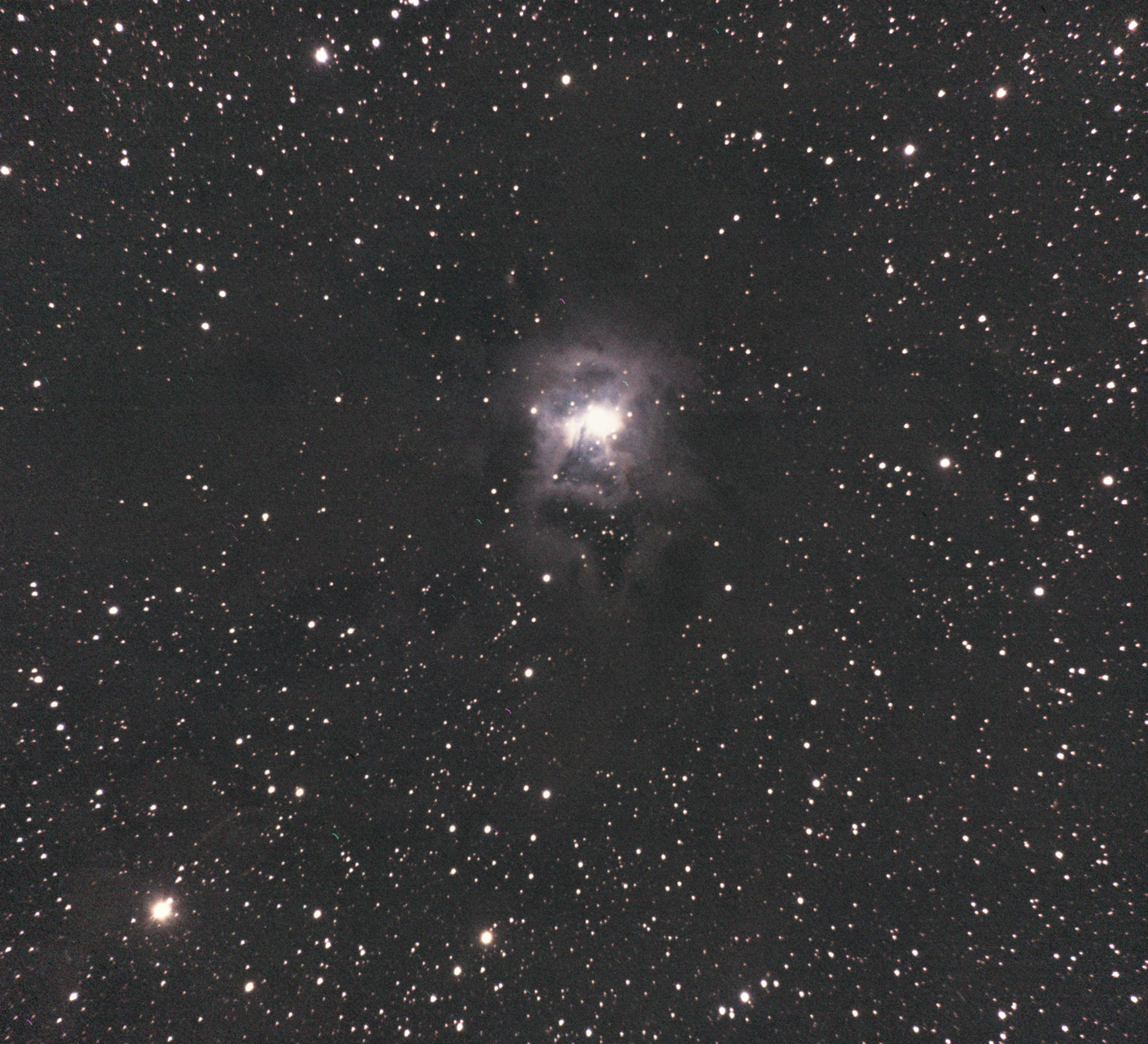 |
| NGC7023 |
 |
| Sharpless 136 |


