Wednesday, March 9, 2016

The trip to Harvard, MA was a bust

One thing you can be sure of is the more things you need for a sky gazing trip out the more chances things can go wrong. More than once I have trekked 45 miles out to Harvard, MA only to have forgotten a key item or have something fail. Once last year it was the AVX mount. Once, with my previous scope, a Meade 127ED, it was ... arrgghh... the 2" to 1.25" adapter. 

The most recent night, 2/6/2016, it was the DC to AC converter I use to power the laptop off of the car battery. It suddenly stopped working. Lacking a spare fuse or a way to test the fuse continuity I cut my night short trying to image on my aging Acer battery. It barely delivered 90 minutes. The one image acquired was not worth keeping.

Now here's the kicker. When I got home a test of the fuse showed it was fine. I plugged the DC/AC converter into the jump starter 12v port and it worked. Huh? I the tried it in the car and after a couple of plugs and unplugs, well it worked. Well at least the 90 mile drive was on $1.49 gas instead of $3.49 gas from a few years ago.

Okay, I blinked first on the Celestron Travel Scope 70

I ordered a Celestron Travel Scope 70 (TS70) from B&H Photo As a bonus they include a free red LED flash light that they value at $12.95*. I also ordered a Celestron Universal Piggyback Mount  from the same vendor.

Mounting the TS70 on the Celestron 8/SCT is simple with the supplied screws and matching pre-drilled holes. The AVX counterweight is not sufficient to counterbalance the SCT, the TS70 and the 9x50RACI finder. Thus in the field I will align the system first with help of the finder.,park the system pointing at Polaris then install the TS70 and remove the 9x50 RACI finder.

I've only had one clear night since procuring the TS70; the day I received it. It was windy and seeing was lousy. Thus, I set up the C8/SCT on the patio with the TS70 riding piggy back. From my south facing patio I cannot see Polaris, so rough aligned with North and used Rigel and Procyon as alignment stars. Below is an image of M42 (Orion Nebula) averaged from 25 8sec exposures.
 
The image is reduced 50% from the original size. The brightest stars are quite bloated which I hope means the can be improved in sharpness with better focusing and IR filtering. This will prove interesting considering the crudeness of this scope's rack and pinion focuser.

Since this first night trial I checked the and improved  TS70's collimation with a Cheshire eyepiece using the shaking method suggested by a  10 Minute Astronomy blog post. Tonight  I'll head out to Harvard MA  to put it through its paces.  This post was originally composed on 3/6/16.

*It turns out, despite containing a 9V battery, the battery appears to be non-standard. Thus, the battery could not be replaced rendering the red flash light useless. 

Sunday, February 21, 2016

Shopping for small refractor

I haven't posted in a while. I've been in Massachusetts for about two months and the weather has been unstable. When mild it's been gray. When clear it's been frigid or the moon has been out.

Meanwhile I'm in the market for a cheap short focus refractor to ride piggyback on the C8 to take wide field deep sky images. Short focus refractors come in a variety of sizes and and prices but I was looking to go cheap skate without too much compromise.

As luck would have it, while watching a YouTube review of the Celestron Nexguide  auto-guider the reviewer mentioned his satisfaction with using a piggyback mounted 70x400 mm Celestron Travelscope as a guide scope. At less than $100 I figured the scope was worth investigating.  Celestron also offers a piggyback mount that mates to several of its scope models.

One  Travel Scope Amazon review included some pretty decent astroimages taken through the scope by the reviewer. Suddenly I was seeing this scope as a credible candidate for a wide field imager. I probably should have bought the scope right after Black Friday when it was as low as $65 from at least one online vendor. Demand for the scope as a Christmas gift caused the price to soar to $90 - $100  going into Christmas until settling to a low of $75 today. I've been holding out hoping a vendor will blink to a lower price but will get one by  Spring.

Thursday, January 21, 2016

Recent DSO Images

The marriage of the Meade DSI, the C8 SCT and the Advanced VX mount is finally starting to pay off. All of my DSO imaging is done unguided. I do perform a two star align followed by four star calibration with an all star polar alignment (ASPA) on a star near the meridian. This is usually enough to give me nice round stars for less than 30 sec exposures unguided.

All images were acquired using Meade Envisage software in FITS file format. NASA / Fits Liberator 3 freeware was used to extract and enhance  R, G and B TIFF files. Paintshop Pro was used to colorize the TIFF files, apply touches to remove blemishes and to recombine them by merging layers.

                Comet C/2013 X1 PANSTARRS

NGC 884 -- Open Cluster

NGC7635 -- Bubble Nebula

NGC869 -- Open Cluster

NGC457 -- Owl Cluster
NGC7331 Spiral Galaxy

Cold night. Bright Open Clusters.

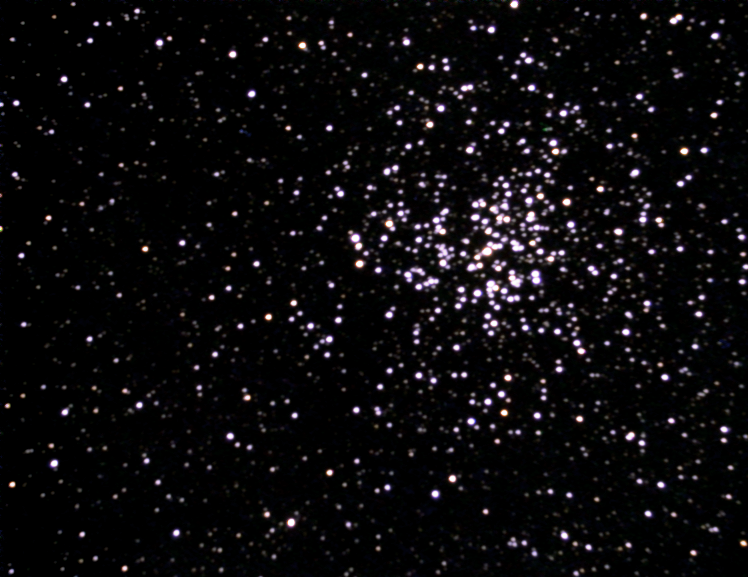
The plan for 1/11/16 was to acquire images of  open star clusters M35, M36, M37, M38, NGC1664, NGC2129, NGC2158 and M78. Only M35, M36, M37, M38 and NGC2129 yielded pictures worth processing.  Images were acquired by averaging 25 to 50 8s exposures. Celestron SCT8, Celestron 0.63x field flattening focal reducer, Antares 0.5x focal reducer. Imaging was done using Celestron AVX mount using 2+4 star alignment and ASPA (all star polar alignment). Otherwise imaging was unguided. 

Images were acquired in LRGB FITS format. Fits Liberator freeware from NASA/ESA was used to extract the red, green and blue TIFF files and make adjustments to bring out faint stars. JASC Paint Shop Pro 9 was used to colorize and merge the R, G, B layers to get the final images. 

M35

M36

M37

M38

NGC2129

Sunday, November 15, 2015

AVX Repaired

This post is about a month after the AVX was returned from repair. I left off my last post saying I was fuming at Celestron.  Kudos to Celestron for fixing my AVX  two weeks faster than expected. 

OTOH, I was not notified by email that the AVX had been shipped. It arrived on my doorstep a day after I returned from a month long trip no signature required. What if I was still away? Theft of shipped goods from peoples' doorsteps have become a common crime.

Also annoying is I emailed the Celestron contact about what was the nature of the failure and if there was anything a user could do to prevent it repeating. I got no response. That said I greatly appreciate the expeditious way Celestron handled the repair.


Thursday, September 24, 2015

Celestron AVX on the Fritz :(((

Did I neglect to mention that my Celestron AVX mount is on the fritz? The drive is only a year old and at the worst possible time, a clear August night in Harvard, MA, scope setup rough aligned with Polaris I hit the on switch and nothing. I checked the fuse in the 12v cigarette lighter plug and it was burned out. I replaced it and still nothing.

I called it a night and when I got home emailed the Celestron AVX Yahoo group for advice. The quick answer was there's no internal fuse. The drive's likely died. WTF?

Contacted Celestron and arranged for a warranty return. Celestron warranties are two years. I hope the Discover card automatic 1 year extension* also applies because this sudden failure does not give me a lot of confidence in Celestron's manufacturing care. Celestron advises repairs take a minimum of six weeks. That really sucks. Meanwhile, here in Maryland, a state not known for clear skies we had had about ten days of clear, low humidity pre-Fall skies.

I'm fuming with Celestron.

*Discover has since taken away this benefit. That really sucks.